The Samsas take in lodgers
The MetamorphosisThe Samsas take in lodgers to survive the financial consequences of Gregor Samsa’s transformation and the loss of his income. The decision appears practical rather than hospitable: the family’s budget has contracted, domestic labor has been redistributed, possessions have been sold, and the apartment, though too large for their circumstances, cannot easily be abandoned. By renting out part of the home, the family turns private domestic space into a source of revenue, but the arrangement intensifies the household’s dependence on strangers and makes Gregor’s exclusion from family life more complete.
Financial Background
The lodgers arrive after the Samsa family has already undergone a severe economic reorganization. Mr. Samsa explains that some money remained from the failed business he had believed left the family with nothing, but that reserve does not restore the household’s former security. Before his transformation, Gregor Samsa had worked with exceptional intensity, rising from junior salesman to travelling representative and placing his earnings directly before his astonished family. He had supported the whole household and had even planned to pay for Grete Samsa’s conservatory education. Once Gregor is confined to his room, that income disappears, and the family must provide for itself through new work and economies.
The financial pressure becomes visible in the structure of everyday life. The maid is dismissed, an enormous charwoman assumes the heaviest cleaning, Mrs. Samsa performs sewing work for a fashion shop, and Grete Samsa takes a sales position while studying shorthand and French in the evenings in hopes of improving her prospects. Family jewellery is sold, and the household repeatedly confronts the fact that its apartment is too large and expensive for its present condition. The family cannot simply move, partly because it believes Gregor could not be transferred easily and partly because despair has paralysed its ability to make a larger change. Renting rooms therefore serves as an immediate economic solution to a crisis that the family cannot otherwise master.
The Lodgers and the Apartment
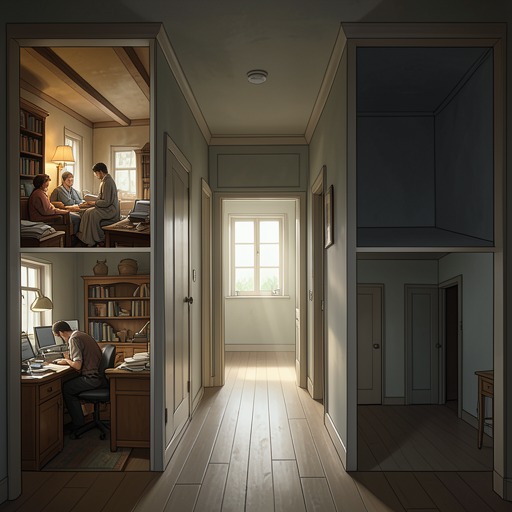
The three lodgers occupy a room in the Samsa family apartment and bring many of their own furnishings and possessions with them. They are described as earnest men with full beards who insist on tidiness not only in their room but throughout the apartment, especially in the kitchen. Their standards alter the hierarchy of domestic space: the paying occupants’ requirements become the measure by which the family organizes itself, while objects that no longer fit the reorganized household are sent elsewhere.
Gregor Samsa’s room becomes the destination for this surplus. Furniture and equipment that cannot be sold or discarded are placed there, along with kitchen dustbins and other items the charwoman has no immediate use for. What begins as forced accommodation becomes a degraded form of occupation. Gregor Samsa has to move through the junk because his room is the only place left where he can crawl, and he eventually finds a grim usefulness in shifting the objects, although the effort leaves him exhausted and sad. The room is no longer treated as a personal space or a place of recovery; it becomes a storage area whose occupant is expected to endure whatever the rest of the apartment cannot contain.
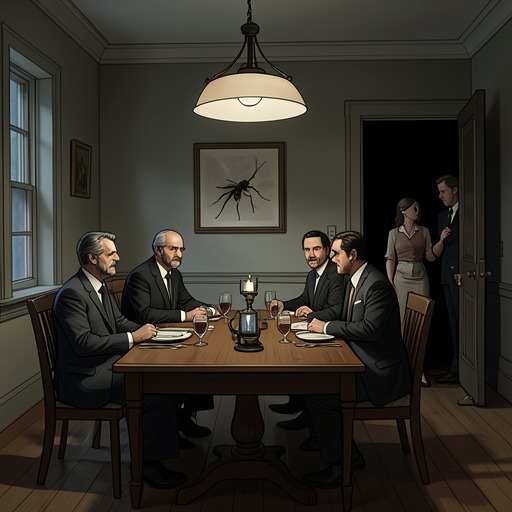
The lodgers also reshape visibility and access. The living-room door, once left open in the evenings so that Gregor could watch his family, is often closed because the lodgers dine there. When it is accidentally left slightly open, they sit at the table where Gregor formerly ate with his parents, while Mrs. Samsa and Grete Samsa serve them steaming meat and potatoes. The family itself eats in the kitchen, and Mr. Samsa bows to the lodgers before joining the others. The arrangement thus reverses the apartment’s former social order: the lodgers occupy the shared dining room as customers, while the Samsas serve them and retreat from their own central domestic space.
Service, Surveillance, and Dependence
The lodgers’ authority is conveyed through ordinary acts of inspection. The middle lodger, who appears to function as the authority among the three, tests the meat before eating it, deciding whether it is sufficiently cooked or should be returned to the kitchen. Mrs. Samsa and Grete Samsa watch anxiously until he approves the dish, and only then do they breathe freely and smile. Their emotional state is tied to the lodgers’ satisfaction, making hospitality a form of service labor governed by evaluation.
The men’s presence also changes the family’s conduct. Their meals are formal and quiet, and their demand for order extends beyond the rented room into the entire apartment. The family must preserve cleanliness, maintain decorum, and avoid exposing anything that might threaten the lodgers’ willingness to remain. Gregor’s existence is especially dangerous within this economy because his room opens onto the domestic areas the lodgers use, and his body contradicts the orderly household image that the family is trying to sell.
This dependence is sharper because the family’s earlier pattern of exchange has already been unsettled. Gregor Samsa once converted labor into money and money into the family’s comfort; now the family’s labor is divided among wage work, sewing, cleaning, cooking, and the service of paying occupants. The lodgers’ rent does not merely supplement the household budget. It establishes a new relation in which the family must perform respectability for outsiders while containing the member whose transformation has made such performance necessary.
The Violin Incident and Rejection
The lodgers’ decisive encounter with Gregor occurs when Grete Samsa plays the violin. They have finished dinner, read newspapers, and smoked when the music begins from the kitchen. At first they become attentive and move quietly toward the hallway door. The middle lodger then asks whether the young woman would play for them in the room, where he considers it more comfortable. The request turns Grete’s music into another service offered to the paying occupants, and the family responds by bringing the performance into the shared living space.
Gregor Samsa hears the violin from his room and recognizes that no one has played it for some time. He is drawn toward the music, believing that Grete Samsa’s playing speaks to something in him that ordinary domestic arrangements no longer reach. His response contrasts with the lodgers’ detached consumption of the performance. They treat the music as an amenity that may be requested, judged, and enjoyed within the terms of their tenancy, while Gregor experiences it as a possible remaining connection between himself and his sister.
When Gregor appears, the lodgers’ presence exposes the family’s deepest conflict. His body disrupts the respectable household the Samsas have tried to maintain for their tenants, and the incident makes the economic arrangement untenable. Grete Samsa declares that the family cannot continue as it is and insists that the creature must be removed; she argues that they have already done everything humanly possible and that they have harmed themselves by continuing to regard it as Gregor. The lodgers then give immediate notice, making their departure a direct consequence of Gregor’s public reappearance in the apartment.
Consequences and Significance
The lodgers’ refusal marks the failure of the family’s attempt to stabilize itself through commercial domesticity. They have entered the apartment as a remedy for financial hardship, but their standards and demands have helped displace the family from its own rooms and have turned Gregor’s confinement into a condition of household solvency. Once the lodgers see him, the distinction between a rented home and a controlled lodging establishment collapses: the family can no longer conceal the person whose transformation structures every part of its economic life.
Their departure also helps produce the family’s final reorientation. After the charwoman reports that the thing in Gregor’s room has been dealt with, Mr. Samsa, Mrs. Samsa, and Grete Samsa leave the apartment together for the first time in months. On the tram they discuss their prospects and discover that all three now have promising jobs. They begin considering a smaller, cheaper, better-located apartment, a space no longer selected and financed through Gregor’s former labor. The lodgers therefore belong to the transitional stage between dependence and recovery: they help reveal how thoroughly the family has reorganized its labor, but their exit allows the Samsas to imagine a future no longer governed by their demands.
In narrative terms, The Samsas take in lodgers compresses the novel’s central tensions into the apartment’s use of space. Gregor Samsa is still physically inside the family home, yet the lodgers receive the best access to its shared rooms; the family serves strangers while treating Gregor as refuse; and music, once tied to Grete Samsa’s private development and Gregor’s protective hopes for her, becomes the event that exposes the incompatibility between human attachment and the household’s economic performance. The lodgers are not merely background tenants. They are the external standard that makes the family’s internal exclusion visible and precipitates the final decision to remove Gregor from the family’s imagined future.